
ADAPTIVE LABS STORIES
The Problem Is in Year 5
Why electric vehicles may outlive the business model designed to finance them.
The car may be ready for Year 6. Is your business model?
For decades, contract fleet management has followed a remarkably consistent logic: acquire, finance, lease for three or four years, recover, sell and start again.
There were good reasons for this. Maintenance exposure, manufacturer warranties, customer expectations and established used-car markets supported the traditional operating cycle. It was a rational response to the economics of conventional vehicles. But what happens when those economics begin to change?
01
When the contract becomes the assumption
A leasing contract defines a commercial relationship between the customer and the fleet management company. It does not define the vehicle’s physical or economic lifespan. Yet traditional contract fleet management has closely linked the two. The first contract frequently determines when the vehicle leaves the portfolio, even if retaining it could create additional value. For conventional vehicles, that approach was often commercially sensible. Electric vehicles invite us to reconsider it—not because they are maintenance-free or because every EV should remain in service for eight years, but because depreciation, operating costs and useful life may interact differently.
02
Depreciation tells only half the story
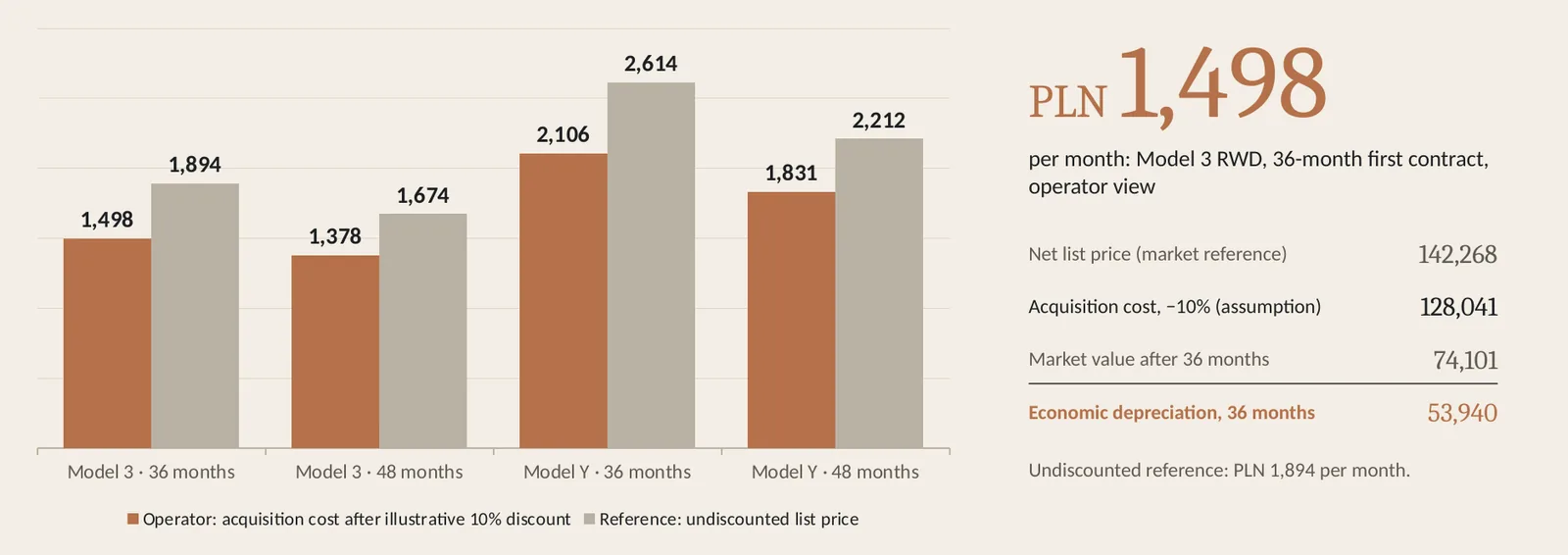
Residual values are commonly expressed as a percentage of the original undiscounted list price. The CFM company’s economic depreciation, however, starts from its actual acquisition cost. Consider an illustrative EV with a net list price of approximately PLN 142,000. A hypothetical 10% acquisition discount reduces the operator’s entry cost to approximately PLN 128,000. If market residual value after three years is around PLN 74,000, monthly economic depreciation is approximately PLN 1,500, rather than PLN 1,900 on the undiscounted list-price basis. The discount is not additional market depreciation: it is the difference between the reference price and the operator’s acquisition cost. The next contract begins from the vehicle’s then-current market value. If the subsequent depreciation curve flattens, the economic cost of a second commercial life may be very different.
Model 3 RWD, first 36-month contract, PLN net of VAT
- Net list price (market reference)
- 142,268
- Acquisition cost after an illustrative 10% discount
- 128,041
- Market value after 36 months
- 74,101
- Operator economic depreciation
- 53,940 · 1,498 per month
- Undiscounted reference
- 1,894 per month
The 10% discount is an assumption, not a verified Tesla fleet discount. It is the gap between the market reference price and the operator’s entry cost, not depreciation in Year 0, and it does not change market residual value.
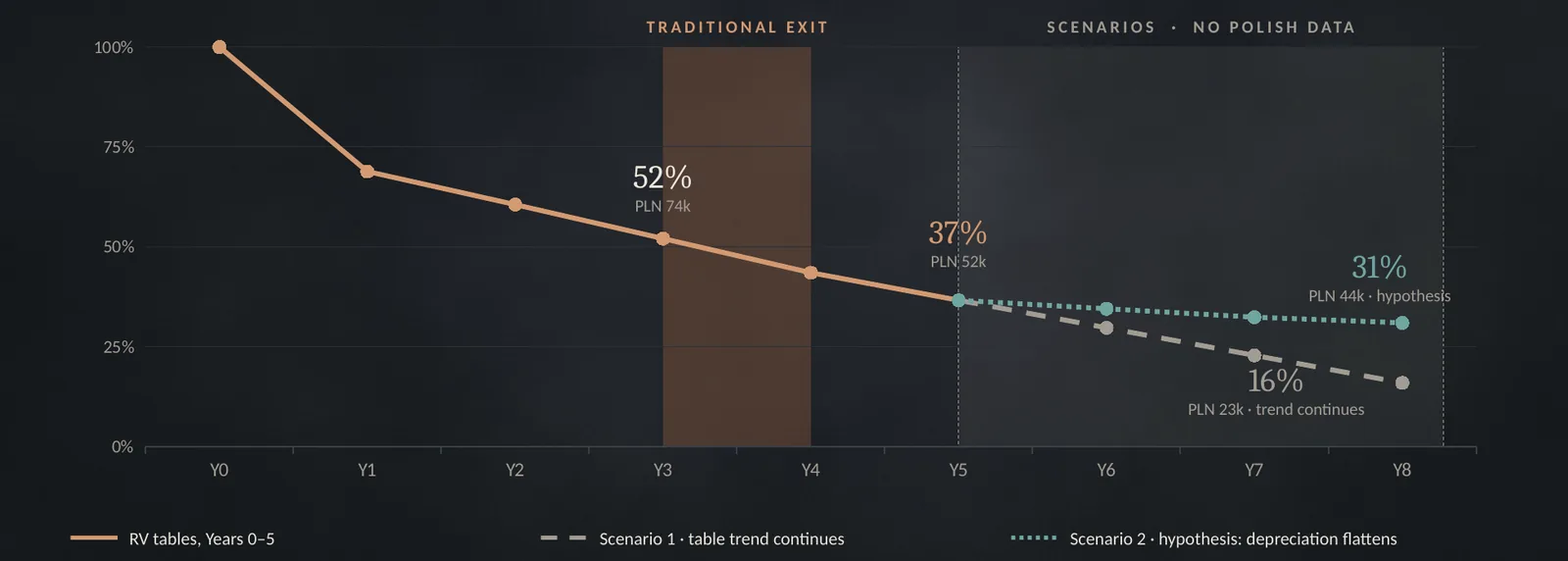
Depreciation is only one component of total vehicle cost. Tyre expenses may remain broadly stable, insurance costs may decline as the vehicle loses value, while maintenance and repair exposure may gradually increase. If these effects broadly offset one another, the lower depreciation of a second-life EV could translate into a meaningfully lower total cost of use. Whether it does is an economic question to be tested, not an outcome to be assumed.
03
The significance of Year 5
At 20,000 kilometres annually, an EV has covered 80,000 kilometres after four years, 100,000 after five, and 160,000 after eight. Certain EV battery and drive-unit warranties extend to eight years, subject to mileage and other conditions. That is not proof of durability, and it does not eliminate repair or battery risks. It does show why the end of a basic warranty should not automatically be equated with the end of useful economic life. The hypothesis worth testing is whether substantial depreciation has already occurred before operating costs become prohibitive. The answer depends on battery condition, future RV, maintenance, insurance, financing, refurbishment, downtime and customer demand.
Example: Tesla EU warranty terms (tesla.com, checked November 2026)
- Basic vehicle warranty
- 4 years / 80,000 km
- Battery and drive unit, RWD
- 8 years / 160,000 km
- Battery and drive unit, Long Range and Performance
- 8 years / 192,000 km
- Minimum battery capacity retention
- 70% over the warranty period
Terms depend on market, model and delivery date. Warranty cover is not evidence of battery durability or profitability.
04
One vehicle. More than one commercial life.
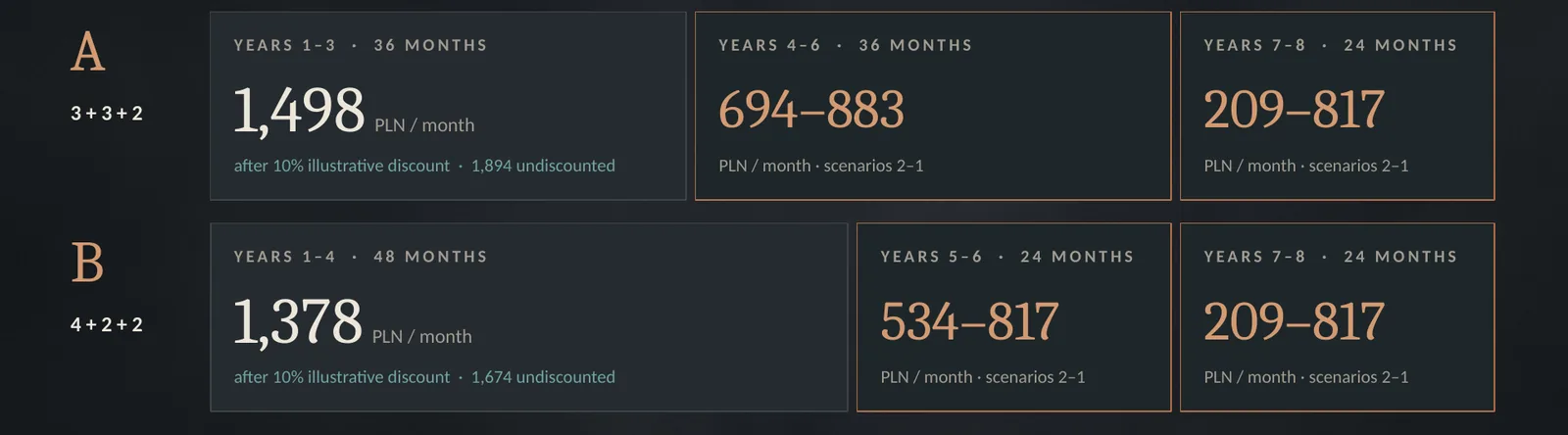
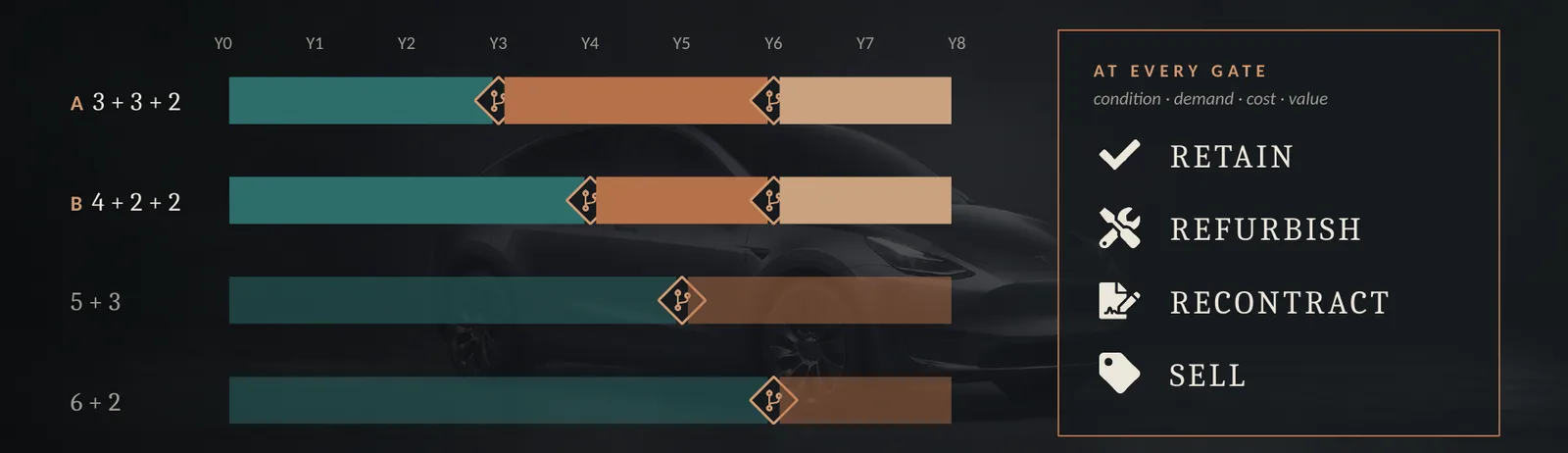
A vehicle might support a three-year contract followed by another three-year contract and a final two-year period; other structures may make more sense. Dividing an eight-year life into contracts does not itself reduce total depreciation, assuming the same acquisition cost and final residual value. It changes the allocation of costs, the commercial proposition and the risks associated with each period. The opportunity is not to retain every EV for eight years. It is to make a deliberate decision at every contract boundary: retain, refurbish, recontract or sell.
05
What if the customer does not need a new car?
A new EV offers updated technology, a fresh warranty and predictable use. Many customers will continue to prefer that. Others may find a well-maintained three- or four-year-old EV more attractive if the monthly cost difference is meaningful. The same customer might extend the first contract; another customer might choose a second-life EV deliberately. A second commercial life is therefore not only an asset-management question. It can create a different choice for the customer—provided the price genuinely compensates for the different vehicle age, warranty coverage and risks.
06
From contract management to lifecycle value management
Managing multiple commercial lives requires capabilities beyond traditional acquire–lease–return–sell processes. Vehicle condition must be assessed at contract boundaries. Battery health should be measured rather than assumed. Maintenance and refurbishment must be evaluated against the value of additional use. Pricing needs to reflect the economics of each period. Finance, operations, risk, remarketing and commercial teams need a shared view of asset value. This is a broader Adaptive Thinking lesson: a business model can remain internally rational after the assumptions that originally justified it begin to change.
07
The real opportunity
Some electric vehicles will still be best sold after three or four years. Others may justify a second commercial life, and a smaller proportion may remain attractive for longer. There is no universal answer. The objective is not to keep every vehicle longer; it is to make a better economic decision at every contract boundary. For the CFM company, this means evaluating the vehicle’s full potential economic life. For the customer, it means a meaningful choice between a new EV and an existing one. The contract ends. The economics don’t.
CLOSING
The contract ends. The economics don’t.
The car may be ready for Year 6. Is your business model?
Methodology note. Polish RV reference data cover Years 0–5; Years 6–8 are scenario assumptions, not observed Polish market data. The illustrative 10% acquisition discount remains an assumption; discount assumptions are not verified Tesla commercial terms. This is a strategic perspective, not investment or vehicle valuation advice.
Related perspectives: Energy & Mobility as a Service · The Connected Enterprise